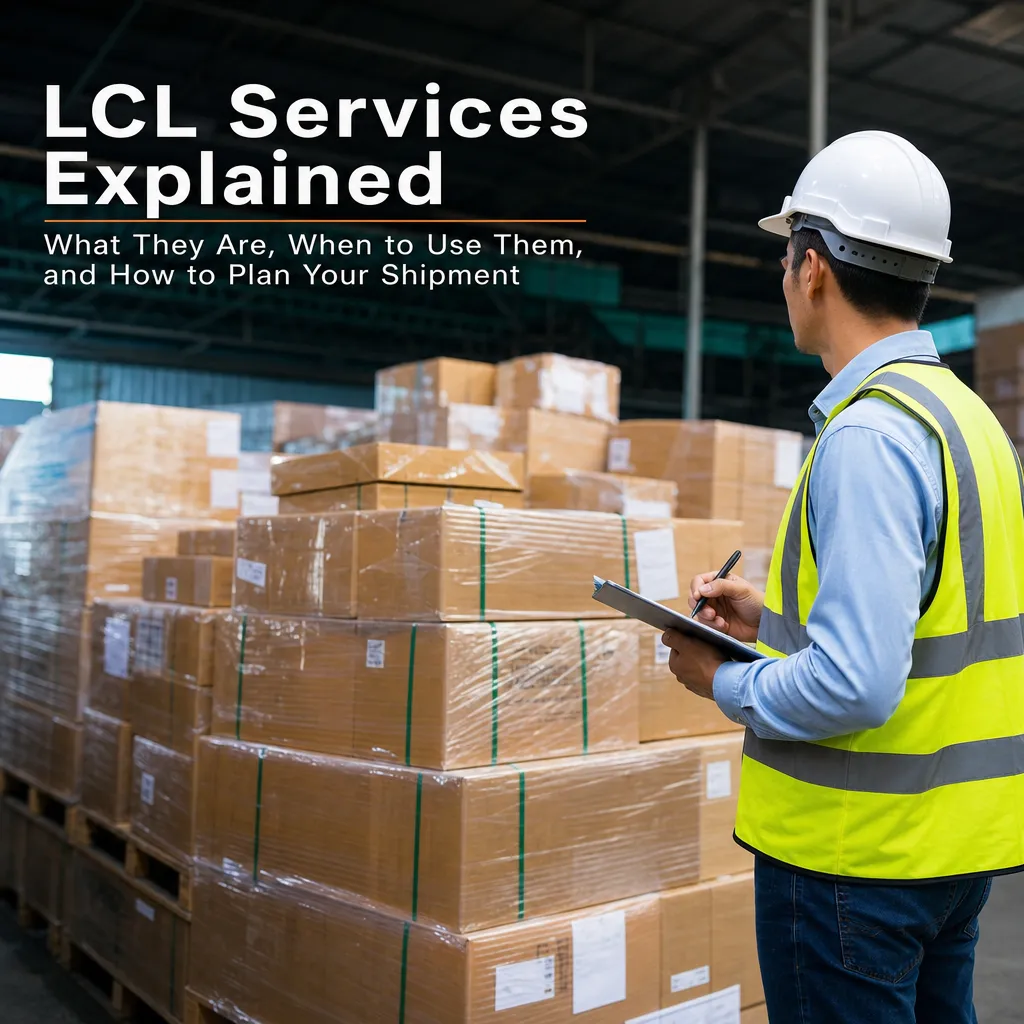
If you’re shipping goods internationally but don’t need an entire container, LCL (Less than Container Load) services are often the most practical option. Instead of renting a whole container, your cargo shares space with shipments from other exporters—making it easier to control cost and flexibility.
Below is a clear, website-ready guide to LCL services: how they work, the benefits and trade-offs, key terms to know, and what to plan so your shipment stays smooth from pickup to delivery.
---
What are LCL services?
LCL (Less than Container Load) is an ocean freight shipping model where:
- You do not fill an entire container
- Your shipment is consolidated with other shippers’ cargo at origin
- The cargo is packed into a container by the consolidator/freight forwarder
- At destination, the container is deconsolidated and your goods are released
In simple terms: you pay for the space you use, while your goods travel inside a shared container.
---
How LCL works (step-by-step)
Here’s what typically happens in an LCL movement:
1. Booking & space confirmation
- Your shipment is booked as LCL with a shipping provider or freight forwarder.
2. Pickup / delivery to consolidation point
- Your goods are collected (or you deliver them) to the port-area warehouse or container freight station.
3. Consolidation
- Your cargo is grouped with other shipments going to the same region/country.
4. Container stuffing
- All LCL cargoes are stuffed into one container.
5. Ocean transit
- The container ships like a standard full container.
6. Deconsolidation at destination
- The container is opened; cargo is separated by shipment.
7. Customs clearance & delivery
- Your cargo clears customs (based on import/export documentation) and moves to final destination.
---
When LCL is the best choice
LCL is usually ideal when:
- Your shipment volume is small to mid-sized
- You want to avoid the cost of a full container
- You need more frequent departures
- Your goods are time-flexible enough to fit consolidation schedules
Common use cases
- E-commerce and small wholesalers importing stock
- Businesses sending replacement parts or seasonal inventory
- Companies shipping mixed goods that don’t justify full container utilization
- Manufacturers testing new markets with lower order quantities
---
LCL vs FCL: what’s the difference?
A quick comparison helps you decide:
LCL (Less than Container Load)
- Cost: Often lower for smaller shipments
- Speed: Can be slower due to consolidation/deconsolidation steps
- Risk: More handling along the way (more touchpoints)
- Tracking: May be more complex since cargo is consolidated and split
FCL (Full Container Load)
- Cost: Usually economical only when you can fill the container
- Speed: Often faster and simpler because the container is yours
- Risk: Fewer handling steps after stuffing
- Tracking: Container-level tracking is typically easier
Rule of thumb: If your cargo doesn’t fill a container and you’re cost-sensitive, LCL often makes sense.
---
Key terms you should understand before shipping LCL
1) Consolidation schedule
LCL shipments are grouped into containers based on departure schedules. This means your transit time can vary compared to FCL.
2) CBM (Cubic Meter) / measurement charge
LCL pricing is often based on:
- Actual weight, and/or
- Volumetric weight (CBM-based)
Always confirm how charges are calculated for your lanes.
3) Service type (door-to-port, port-to-port, door-to-door)
You’ll see multiple service formats depending on who handles pickup, customs, and delivery.
4) Handling and terminal charges
LCL frequently involves:
- warehouse/storage
- documentation and terminal processing
- deconsolidation charges at destination
These can affect the final landed cost, so it’s smart to ask for a clear cost break-up.
---
Benefits of LCL services
LCL is popular for good reasons:
- Lower shipping cost for smaller volumes
- More shipment flexibility without waiting to fill a container
- Access to international routes even for smaller exporters/importers
- Better market testing—you can send trial quantities without large commitments
---
Trade-offs and common challenges with LCL
While LCL can be economical, it comes with practical considerations:
- Longer lead times due to consolidation/deconsolidation
- More handling increases the importance of strong packaging
- Potential customs delays if documentation is incomplete
- Mixed cargo dynamics—your cargo’s release can depend on how quickly consolidation is finalized
Understanding these upfront helps avoid surprises.
---
How to prepare your cargo for LCL (to reduce risk)
If you want LCL to be smooth, focus on preparation:
1) Use proper packaging for multiple-handling
- Secure cartons on pallets where appropriate
- Use moisture protection if required
- Ensure labeling is visible and correct
2) Provide accurate dimensions and weight
Inaccurate measurements can lead to:
- incorrect pricing
- loading/stuffing inefficiencies
- shipment disputes
3) Keep documents consistent
Customs and clearance depend on alignment across:
- invoice
- packing list
- HS code classification
- shipping marks/labels
4) Use clear packing lists
For LCL shipments, clarity is critical since cargo is separated later. Make sure your packing list is easy to verify by quantity and item.
---
Customs clearance: why it matters for LCL
Even though LCL is an ocean freight concept, the “landed cost” experience often depends on customs processing.
To avoid delays, you should ensure:
- Correct HS codes
- Accurate commercial invoice values
- Correct product descriptions
- Any required certificates or compliance documents
- Compliance with regulations for your product category (food, chemicals, electronics, etc.)
Many shippers rely on freight-forwarding and brokerage support to manage these steps efficiently—especially when documentation requires careful attention.
---
Is LCL good for time-sensitive shipments?
For urgent goods, LCL may not always be ideal due to consolidation schedules. If you’re shipping something that must arrive by a strict deadline, consider:
- FCL (if volume supports it)
- Air freight (when urgency outweighs cost)
- Choosing departures with tighter transit control
If you do choose LCL, plan your timeline early and build in buffer time for consolidation and customs.
---
Pricing: what influences the cost of LCL?
LCL costs can depend on:
- CBM volume (sometimes compared against weight)
- lane and routing
- origin and destination fees
- peak season surcharges
- customs documentation complexity
- insurance requirements
- warehouse/terminal handling
A practical approach is to ask for a line-item quote so you understand what you’re paying for—not just freight.
---
A practical example (how businesses use LCL)
Imagine a Delhi-based importer who wants to stock a product line but only has a small order quantity. Instead of waiting until they can fill a full container, they book LCL space. Their goods are consolidated with other cargo at the port area, then shipped and deconsolidated at destination.
In real operations, businesses often pair LCL movement with customs coordination so the cargo can clear smoothly and move to final delivery—particularly when documentation or compliance requires extra care. For instance, some importers work with logistics partners that handle both freight coordination and customs formalities under one workflow.
---
Common misconceptions about LCL services
Misconception 1: “LCL is always cheaper”
LCL can be cheaper for smaller volumes, but landed cost depends on charges like handling, terminal fees, and clearance complexity. Sometimes FCL can become competitive if your goods are near full-container utilization.
Misconception 2: “Transit time is the same as FCL”
LCL transit may be longer because consolidation and deconsolidation add steps before and after ocean transit.
Misconception 3: “Any packaging is fine”
Since LCL cargo may be handled more times, packaging quality is especially important. Poor packaging can lead to claims and delays.
---
Checklist: questions to ask before booking LCL
Before you confirm an LCL shipment, ask:
- How is pricing calculated—CBM, weight, or both?
- What are the all-in charges (terminal/handling/documentation/storage)?
- What is the expected consolidation schedule?
- Which documents are required for customs?
- Will you provide guidance on HS code and product compliance?
- Do you offer options for insurance coverage?
- Is the service port-to-port, door-to-port, or door-to-door?
---
Final takeaway
LCL services are a smart way to ship internationally when your volume doesn’t justify a full container. The key to success is planning around consolidation timing, preparing cargo properly, and ensuring customs documentation is accurate and complete.
If you’re organizing LCL shipments alongside import/export coordination, working with a logistics team that can manage both freight movement and documentation can reduce friction—especially for businesses dealing with mixed cargoes, regulated product categories, or frequent shipment schedules.
---
If you tell me your origin country/city, destination country/city, product type, and approximate volume (CBM or carton count), I can suggest whether LCL vs FCL makes sense and what a realistic timeline might look like.
Keywords